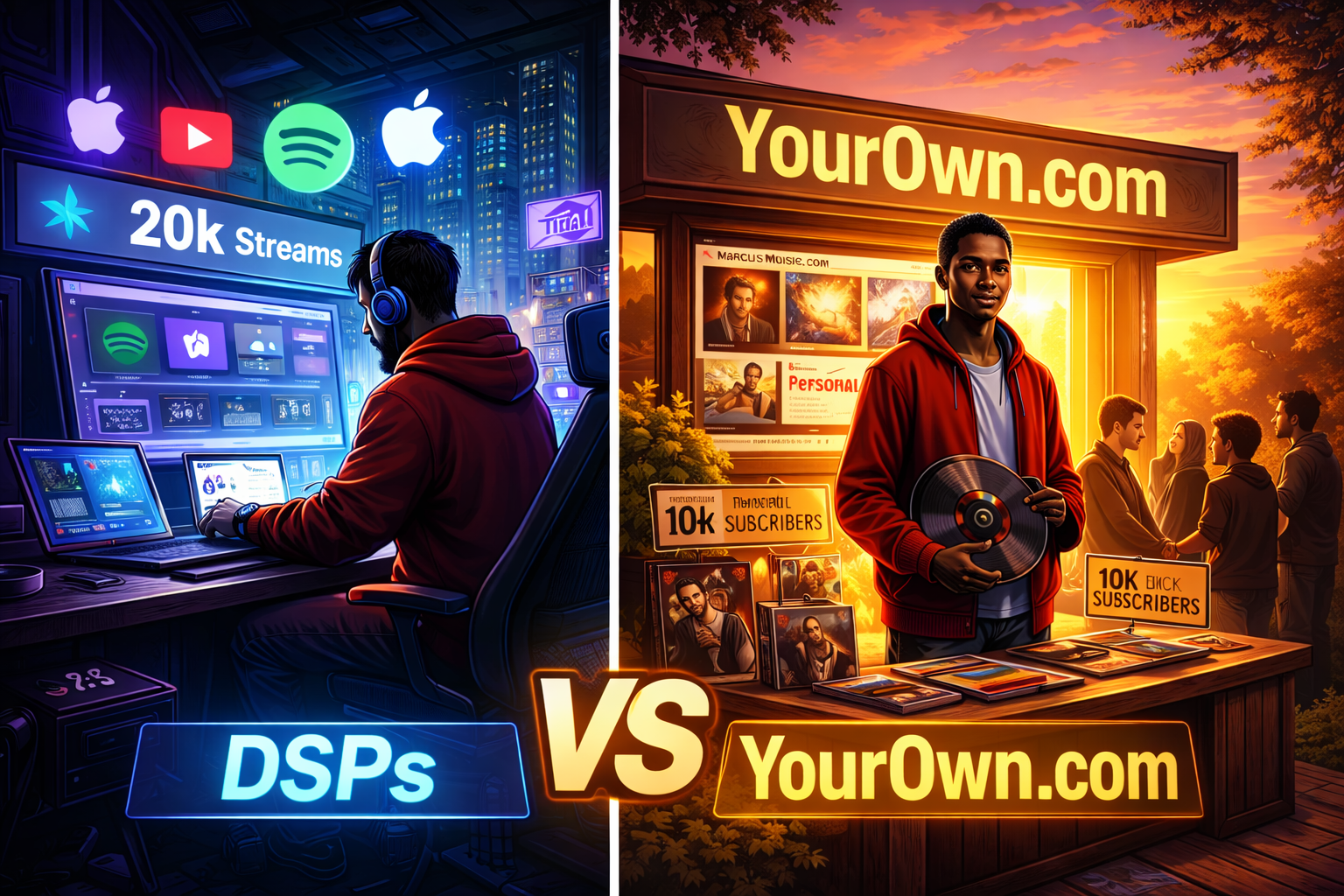
Every night, Marcus uploaded his music to the DSPs.
Spotify. Apple Music. YouTube Music.
Green checkmarks. Blue links. A sense of progress.
The numbers would climb—sometimes fast, sometimes painfully slow. A playlist add felt like winning the lottery. A spike in streams brought a rush… and then silence. When the month ended, the payout landed like loose change on a kitchen counter. Enough to notice. Never enough to build with.
Marcus didn’t own any of it.
The DSPs decided who saw his music, when it was pushed, and how far it traveled. One algorithm tweak and yesterday’s momentum vanished. One policy change and a song could disappear overnight. His fans followed platforms, not him.
He was renting space in someone else’s house.
Then one day, Marcus built his own .com.
At first, it felt small. Quiet. No instant validation. No playlists. Just a homepage, his story, his catalog, and an email signup sitting there patiently like an empty venue before doors open.
But something changed.
When fans came to his site, they didn’t scroll past him—they arrived.
No distractions. No competing artists. No autoplay sending them elsewhere.
They bought music directly.
They grabbed merch.
They joined his mailing list.
For the first time, Marcus knew who his fans were.
Emails instead of streams.
Relationships instead of reach.
Ownership instead of permission.
When he dropped new music, he didn’t wait for an algorithm to approve it. He pressed send. When a DSP playlist ignored him, it didn’t stop the release. His site was still live. His audience was still there.
The DSPs became what they were always meant to be: billboards, not homes.
Discovery tools—not the foundation.
Marcus still uses DSPs.
But now, every link leads back to him.
Because streams come and go.
Platforms rise and fall.
Algorithms forget.
But a .com doesn’t.
That’s not just a website.
That’s ownership.
That’s leverage.
That’s legacy.
And once Marcus understood the difference…
He stopped chasing the industry
and started building his own.